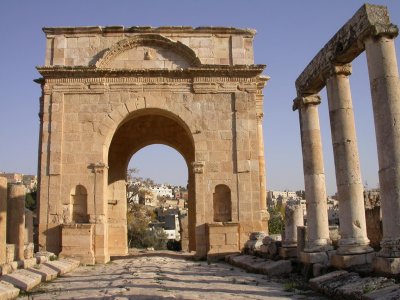
Jerash, located 45 kilometers north of Amman is considered one of the largest and most well-preserved sites of Roman architecture in the world outside Italy. To this day, its colonnaded streets, baths, theaters, plazas and arches remain in exceptional condition. Within the remaining city walls, archaeologists have found the ruins of settlements dating back to the Neolithic Age, indicating human occupation at this location for more than 6500 years. This is not surprising, as the area is ideally suited for human habitation. Jerash is fed year-round with water, while its altitude of 500 meters gives it a temperate climate and excellent visibility over they surrounding low-lying areas.
The history of Jerash is a blend of the Greco-Roman world of the Mediterranean basin and the ancient traditions of the Arab Orient. Indeed, the name of the city itself reflects this interaction. The earliest Arab/Semitic inhabitants, who lived in the area during the pre-classical period of the first millenium BCE, named their village Garshu. The Romans later Hellenised the former Arabic name of Garshu into Gerasa, and the Bible refers to "the region of the Gerasenes" (Mark 5:1; Luke 8:26). At the end of the 19th century, the Arab and Circassian inhabitants of the small rural settlement transformed the Roman Gerasa into the Arabic Jerash.
It was not until the days of Alexander the Great that Jerash truly began to prosper. After falling under the rule of the Seleucid King Antioch in the second century BCE, Jerash was conquered by the Roman Emperor Pompey in 63 BCE. It was during the period of Roman rule that Jerash, then known as Gerasa, enjoyed its golden age. The Romans assimilated Jerash into the province of Syria, and later named it as one of the great cities of the Decapolis League. The Decapolis was a prosperous confederation of ten Roman cities formed during the first century BCE, and linked by powerful commercial, political and cultural interests. Pliny mentioned the confederation in his Natural History, listing the cities as Damascus, Philadelphia (now Amman), Gerasa (Jerash), Scythopolis (Beisan), Gadara (Umm Qais), Hippos, Dion, Pella, Canatha and Raphana.
Over the next century and a half, trade flourished with the Nabateans and Jerash prospered. The city also benefited from the rich surrounding farmlands and from iron ore mining in the Ajloun area. This period saw the implementation of a typically Roman city plan featuring a colonnaded main street intersected by two side streets.
In 106 CE, the Emperor Trajan annexed the wealthy Nabatean kingdom and formed the province of Arabia. The Romans secured lines of communication and trade with the Via Nova Triana (Trajan New Road), which was built between 112-114 CE and stretched all the way from Syria to Aqaba. With even greater trading riches pouring in, Jerash enjoyed another burst of construction activity. Granite was brought from as far away as Aswan (Egypt), and old temples were razed and rebuilt according to the latest architectural fashion.
The city received yet another boost in stature with the visit of Emperor Hadrian in 129 CE. To honor its guest, the citizens raised a monumental Triumphal Arch at the southern end of the city. Jerash's prosperity reached a peak in the beginning of the third century, when the rank of Roman Colony was bestowed upon it. During this "golden age", Jerash may have had a population of 20,000 people. The ancient city preserved today was the administrative, civic, commercial and cultural center of this community, while the bulk of the city's citizens lived on the east side of Wadi Jerash. As the third century progressed, shipping began to supplant overland caravans as the main route for commerce. Jerash thus fell into decline as its previously lucrative trade routes became less traveled and less valuable. This trend was speeded by frequent uprisings against the Romans "such as the destruction of Palmyra in 273 CE†that made the overland routes more dangerous.
In the year 330 CE, Emperor Constantine converted to Christianity and proclaimed it the state religion of the empire's eastern, or Byzantine, half. By the middle of the fifth century, Christianity had become the major religion of the region and numerous churches were constructed in Jerash. In fact, most of these were built of stones taken from pagan temples. No more churches were built after the year 611 CE.
Jerash was hit further by the Persian invasion of 614 CE, which also sacked Damascus and Jerusalem, and by the Muslim conquest of 636 CE. The city was rocked again in the year 747 CE by a series of earthquakes, and its population shrunk to about 4000. Although the site was occupied in the early Islamic period until around 800 CE, Jerash was nothing more than a small rural village.
The Crusaders described Jerash as uninhabited, and it remained abandoned until its rediscovery in 1806, when Ulrich Jasper Seetzen, a German traveler, came across and recognized a small part of the ruins. The ancient city was buried in sand, which accounts for its remarkable preservation. It has been gradually revealed through a series of excavations which commenced in 1925, and continue to this day.
Tickets to the ruins are available at the Jerash Visitors' Center at the South Gate. There, you can also find free maps of Jerash as well as souvenir shops selling guidebooks and trinkets. The ruins are open from around 07:00 until dark. From July through October, sound and light shows take place from 20:30-22:30. Call the Visitors' Center (tel. 02-635-1014) for details.
A walk through Jerash is a journey in time. Enter the city as its Roman inhabitants did: through the monumental South Gate, into the imposing Oval Plaza. Make your way down the Cardo, or "Colonnaded Street", and as you step over the tracks of chariot wheels still visible in the paving stones, imagine a group of well-off people window-shopping beneath a covered sidewalk.
1. Hadrian's Arch
Built to commemorate the visit of the Emperor Hadrian to Gerasa in 129 AD, this splendid triumphal arch was intended to become the main southern gate to the city but the expansion plans were never completed. One unusual feature of its construction is the wreaths of carved acanthus leaves above the bases of the pillars.
2. Hippodrome
The massive arena, 245 m long and 52 m wide (only part of which has been restored) could seat 15000 spectators to watch athletic competitions, horse races, chariot races, and other sports. The exact date of its construction is unclear; between the mid-2nd and 3rd centuries AD.
3. City Walls & South Gate
Approaching the city from the Visitor's Center, you see the impressive city walls, built at the beginning of the 4th century, most probably by Emperor Diocletian, and repeatedly expanded afterwards. The present walls are Byzantine and had a total length of 3456 m. The South Gate through which you enter Jerash, dates from 130 AD and has a characteristic carved acanthus-leaf decoration. The open area inside the gate was used as a marketplace, and a 2nd century olive press is visible behind a wooden screen.
4. Oval Plaza
The spacious plaza measures 90 x 80 m and is surrounded by a broad sidewalk and a colonnade of 1st century Ionic columns. There are 2 altars in the middle, and a fountain was added in the 7th century AD. This square structure now supports a central column, which was recently erected to carry the Jerash Festival flame.
5. The Cardo "Colonnaded Street"
Still paved with the original stones - the ruts worn by chariot wheels still visible - the 800 m Cardo was the architectural spine and focal point of Gerasa. The colonnaded street was remodeled in the late 2nd century AD, probably after 170 AD. The Ionic columns were replaced by more elaborate Corinthian columns. On either side was a broad sidewalk with shops, which can still be clearly seen. An underground sewage system ran the full length of the Cardo, and the regular holes at the sides of the street drained rainwater into the sewers.
6. Macellum
Halfway up the Cardo, the Colonnade becomes larger and taller, marking the entrance to the Macellum or market place, a building to the left of the colonnaded street. The inscription on the adjacent lion's head fountain is dated 211 AD.
7. Umayyad Mosque
A newly excavated Umayyad mosque. Currently under excavation as of Aug 2006!
8. South Tetrapylon
The intersection of the Cardo with the first cross street, the South Decumanus, was marked by 4 still visible pedestals, which supported columns and probably a pyramidal structure.
9. South Bridge
To the right, the south Decumanus runs east to a 73 m bridge which led to the town wall and residential quarter of Gerasa. Most of this is now buried under modern Jerash, with the exception of the East Baths, which can be seen across the modern road to the left of the mosque.
10. Umayyad Houses
At the western end of the South Decumanus is an Early Islamic Umayyad housing quarter inhabited from 660 to 800 AD. The south bridge led to the residential quarter and to the eastern gate.
11. The Cathedral
Further up the Cardo on the left is the monumental and richly carved gateway of the 2nd century Roman Temple of Dionysus. In the 4th century the temple was rebuilt as a Byzantine church, now called the Cathedral, although there is no evidence it was more important than any other church. At the top of the stairs, against an outer east wall of the Cathedral, is the Shrine of St. Mary, with a painted inscription to St. Mary and the archangels Michael and Gabriel.
12. Church of Saint Theodore
Lying above and behind the Cathedral, this large church was built in 496 AD. In between St. Theodore's and the West Side of the Cathedral entrance is a small paved piazza with a fountain in the center; this Fountain Court was originally the Cathedral atrium. The course of the underground lead pipe which fed the fountain can be seen as a line of obliquely laid stones northeast of the fountain.
13. Nymphaeum
This ornamental fountain was constructed in 191 AD, and dedicated to the Nymphs. Such fountains were common in Roman cities, and provided a refreshing focal point for the city. This fine example was originally embellished with marble facings on the lower level and painted plaster on the upper level, topped with a half-dome roof Water cascaded through 7 carved lions' heads into small basins on the sidewalk and overflowed from there through drains into the underground sewer system.
14. Propylaeum
The procession to the Temple of Artemis originally started across the river in the part of Gerasa now covered by modern Jerash.
Crossing the Cardo, worshippers approached the impressive entrance to the processional way leading up to the Temple of Artemis. Its massive columns and a carved portico were flanked by 2-storey shops.
15. Temple Esplanade
The monumental staircase, originally enclosed by high walls, leads up to a U-shaped terrace where an open-air altar was built, the foundations of which are still visible. A second staircase leads through a colonnade of 22 Corinthian columns and into the Temenos.
This sacred precinct, 162 x 121 m, was defined by Corinthian columns on all 4 sides.
16. Propylaeum Church
Opposite the Propylaeum, this Byzantine church was built in the 6th century on the site of a colonnaded courtyard which formed part of the processional way. The columns were used as part of the church.
17. Naghawi's Mosque
On the right, behind 4 standing Corinthian columns is what seems to be an Ayyubid or Mamluk mosque discovered in 1981. This was probably built sometime during the 12th-15th centuries, using materials from the colonnaded atrium of a Roman house that stood there.
18. West Baths
The massive West Baths, on the right, covered an area of 50 x 70 m and now lie where they fell after the earthquake of January 749 AD.
Typical of the 2nd century, the Baths were an imposing complex of hot and cold rooms and other facilities.
19. North Tetrapylon
The second Tetrapylon, located where the North Decumanus or cross street intersects the Cardo, was built during Jerash's redesign, probably as a monumental entrance to the North Theater. At a later date, it was dedicated to Julia Domna, the Syrian wife of Emperor Septimius Severus, and probably had a domed roof in the 2nd century AD, elaborate carved decoration, arches and 4 sides to allow traffic to pass through.
20. North Colonnaded Street
Beyond the North Tetrapylon is a stretch of the Cardo that was never widened, and retains its simple Ionic columns.
21. North Gate
At the end of the Cardo, the North Gate was built in 115 AD. Its odd wedge shape was probably necessary to align the gate on the inside with the Cardo, and on the outside with the Roman road, which led north to the Decapolis city of Pella.
22. North Theater
Just off the North Decumanus, the North Theater was built in 165 AD. In front is a colonnaded plaza where a staircase led up to the entrance. The theater originally had only 14 rows of seats, and was used as a performance stage as well as the city council chamber; the names of the tribes represented in the council are inscribed in Greek on some of the seats, along with those of several gods.
In 235 AD, the theater was doubled in size to its present capacity of 1600. Two vaulted passages formed the entrance to the orchestra, and spectators entered through passages between the upper rows of seats. The theater fell into disuse in the 5th century, and in later centuries, many of its stones were taken for use in other buildings.
23. Church of Bishop Isaiah
Built in 559 AD, this Byzantine church was used until the earthquake of 749 AD.
24. Temple of Artemis
Artemis , daughter of Zeus and sister of Apollo, was the patron goddess of Gerasa. This Temple was a place of sacrifice dedicated to Artemis and built in 150. Although small, the temple's Corinthian columns soar impressively from the hilltop site; 11 of the 12 front columns are still standing. The temple's inner chamber was originally clad with marble slabs and housed a shrine which probably contained a statue of the goddess.
25. Three Churches
At least 15 Byzantine churches have been found in Jerash, and more are thought to remain buried. Three of the finest are grouped together round a shared atrium. At the north, the Church of St. Cosmos and St. Damian, twin brother doctors who were martyred in the 4th century, has the most splendid floor mosaics to be seen in Jerash. An inscription dates the mosaic to 553 AD, and the images include the churchwarden Theodore with his wife Georgia, praying with widespread arms.
In the center, the church of St. John the Baptist dates from 531 AD. Its mosaic floor, now damaged, included images of the four seasons, plants and animals, and the cities of Alexandria and Memphis in Egypt.
The church of St. George, at the south, was built in 530 AD, and continued to be used after the earthquake of 749 AD. Its mosaics were therefore destroyed when the 8th century Christian iconoclastic movement banned the representation of humans and animals.
26. Church of St. Genesius
The floor mosaic of this church dates back to its dedication in 611 AD, just 3 years before the Persian invasion.
27. Saints Peter and Paul Church
This church complex has a nice mosaic but they aren't as grandiose as the other church complex at Jerash.
28. South Theater
Built during the reign of Emperor Domitian, between 90-92 AD, the South Theater seats more than 3000 spectators and serves today as the primary venue for the Jerash Festival of Culture and Arts. The first level of the ornate stage, originally 2-stories has been reconstructed and is still used today. The remarkable acoustics allows a speaker at the center of the orchestra floor to be heard by the entire auditorium without raising his/her voice.
Two vaulted passages lead into the orchestra, and four passages at the back of the theater give access to the upper rows of seats.
Some seats could be reserved and the Greek letters which designate them can still be seen. For those who wish to climb more steps, the top row of seats affords an excellent view of the Jerash ruins.
29. Temple of Zeus
Erected in 162 AD, this temple stands on ruins of earlier sacred sites. From the Oval Plaza, a staircase leads up to an esplanade (in front of the temple), which was a Temenos, or sacred precinct. Originally, a rock in the esplanade served as a high place, and was enclosed into a shrine (Naos) in 100-80 BC.
This shrine was modified in 69-70 AD and in the 2nd century AD, probably under Emperor Hadrian. From there, another staircase led to the temple, which was originally surrounded by 15 m high Corinthian columns.
30. The Museum
Not to be missed when you visit Jerash is the Archaeological Museum, which houses a fascinating collection of artifacts found at the site. These include gold jewelry, coins, glass and perhaps the most unusual pottery theater tickets.
Hours: 8:30 - 17:00 in winter, 8:30 - 18:00 in summer, 10:00 - 16:00 on official holidays. Admission is free.
Jerash Festival of Culture and Arts
Visitors to Jerash in July are in for a special treat, when the Jerash Festival transforms the ancient city into one of the World's liveliest and most spectacular cultural events. Two thousand years ago, the great urban trading cities of the Middle East were born when Middle Eastern and Western societies came together in a tremendous synthesis of commerce, art, and culture.
Their legacy shines today in the splendid cities of the Greco-Roman and Arab East, such as Petra, Jerash, Gadara, and Palmyra. The full power and glory of that ancient drama is revived in Jordan every summer in the form of the two-week Jerash Festival of Culture and Arts bringing together local folklore dancers and troupes from allover the World.
The Jerash Festival usually takes place during end of July and beginning of August. It showcases a wide array of singers, musical and folklore troupes, poetry readings, symphony orchestras, ballet, Shakespearean theater, handicrafts, and art shows. Special acts and exhibitions cater to children, making the festival an attractive destination for the entire family.
The colonnaded streets, plazas, and theaters of Jerash all provide unique venues for these acts, under the balmy summer skies of central Jordan. While performances take place in the different arenas, thousands of visitors also enjoy strolling through the ancient streets and monuments of the city, shopping for handicrafts, taking in art and book exhibitions, enjoying a casual meal, or simply absorbing the powerful drama of East and West meeting in a great cultural jamboree. Skilled craftsmen and women display Bedouin rugs, jewelry, embroidery, glass, wood, metal, and ceramicss, and also demonstrate on the spot how they create their wares.